
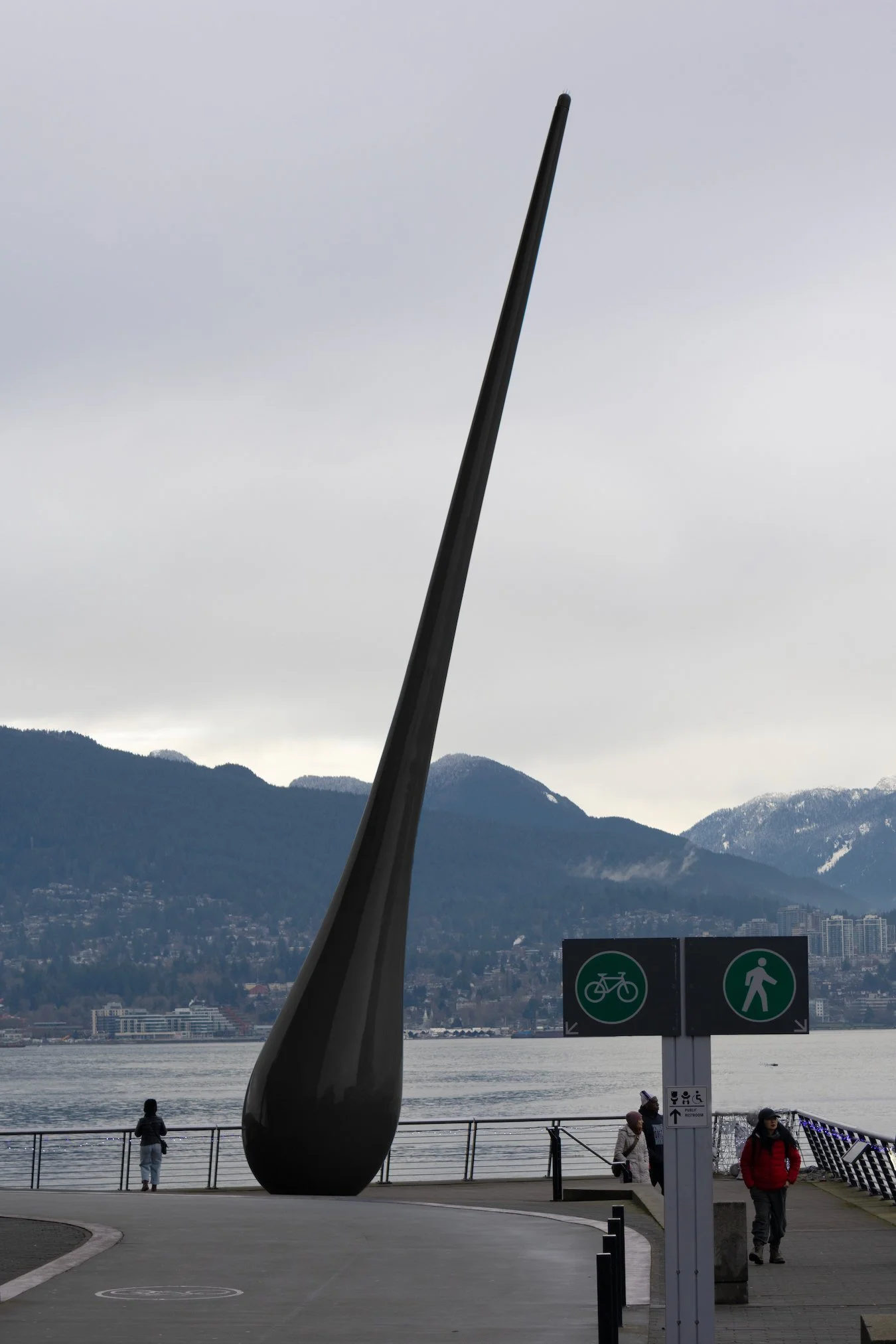
A Single Drop of Oil
altered photograph
2025
The Drop (2009) is a public artwork in Vancouver, BC, by Inges Idee, German artists working internationally, specializing in large-scale whimsical public installations. The work was manufactured in Alberta by Heavy Industries, with a polyurethane shell over expanded polystyrene. It is the image of a 65-foot tall giant blue raindrop, presumably chosen for its appropriateness to BC’s rain-soaked climate. According to the artist’s statement about the work, “it marks the interface between land and water, between nature and technology.” The work is installed beside the Vancouver Convention Centre, across from Canada Place, on Burrard Inlet.
Water is increasingly an issue for municipalities world-wide, due to massive shifts in climate patterns, and Vancouver is no different; but the fact is that these shifts are almost entirely due to the unregulated use of fossil fuels, which are increasingly raising the planet’s temperature to unsustainable levels. The technology of The Drop is that it is constructed entirely of plastics derived from petroleum.
In Vancouver, and Burrard Inlet in particular, the vigorously-contested expansion of the Trans Mountain Pipeline, from Alberta’s Tar Sands to tidewater near the head of the inlet, has put the region at risk of oil spills from the $53-billion tripled capacity of the pipeline, which loads diluted bitumen into tankers that then traverse the length of the inlet. (These tankers are not fully loaded, because the inlet is not deep enough to accommodate a filled tanker; there is now talk of dredging the inlet.) The plan is for over 400 tankers a year to pass through this narrow body of water, past The Drop, to global destinations where the burning of refined tar-sands crude will contribute hugely to our current existential crisis. It is a fitting irony that the sculpture sits on Bon Voyage Plaza.
The work in its present form is insufficient to address the magnitude of the potential damage facing Vancouver, the region and the entire globe. Water is an issue, yes; but the far more pressing issue is the fact of our continuing resource-extraction contribution to greatly increased global carbon levels, along with real potential for colossal environmental accidents.
It would seem, therefore, that an adjustment to The Drop could act as a constant reminder, to visitors and citizens, of the true nature and consequences of our global addiction to oil. The simple expedient of repainting the sculpture gloss black would immediately create a fitting and meaningful object more in tune with the critical reality of our present choices.