
Road Work
2010 – present
Maybe it has to do with having spent 50 years in the art industry, but my relationship to the visual field is not ordinary. I have developed a highly attenuated and discriminatory sensibility that allows me to see things others often miss. A chronic myopia, which foregrounds miniscule detail and the microscopically overlooked, has contributed to aspects of this, but there is also keen awareness of the macro field and the complex of relationships that crowd into it. Showing students things in their work, spending countless hours in museums and galleries looking at objects (every detail of which expresses an articulated intention) formed the ground of an intense visual education.
The rolling green hills of Normandy have an uncommonly soothing look. It is the kind of landscape we take solace in. But why is this landscape so comforting? These fields have been plowed to softness for centuries; every season they have been slowly groomed and massaged until simple clarity is the result. There has been no instantaneous mastering – this has been very long, very slow, very arduous labour – but a quiet attendance to nature and necessity. What we now see is the consequence of deliberate if uncasual choices. Contrast this with the Japanese garden, another space of enduring human attention, which has a similar tranquil effect, from a different form of deliberation. Each are human constructs, and each are a pleasure.
For the year I lived among peasants in France, I watched their regular and habitual attendance to the soil, the landscape, the animals, the trees; all this they did as a matter of course, because things needed doing, and now was the time. There was no discussion; it was what you did. Centuries of variations on a theme passed an assuaging hand across the landscape.
About fifteen years ago I quit my day job. I was at home working, looking out the window more than usual. The place where I live is a warehouse in an industrial zone, and the streets are regularly strewn thick with trash; the accumulation is astonishing. Vancouver is a very trash-friendly city. When it comes to trash, practically everywhere is a free-fire zone, but the industrial zones are especially loaded. Something about the word "industrial" suggests an acceptable surplus of by-products: all the mad detritus of production and consumption, overflowing from the dumpster in the lane, invites contributions in kind.
In my ire, I found myself sawing an old chestnut: somebody should do something about this. And that somebody should be the city: a corporation, after all, and therefore a person, and the recipient of generous property taxes. But the fact is the city has neither the resources nor the personnel to really look after such things adequately. Yes, everybody wants boulevard trees, scores of thousands of them – block after block of magnificent chestnuts and elms, maples and cherries, plums and hawthorns – wonderful! But nobody likes the fact that, every year, they actually drop their leaves. And while the municipality can’t keep up with what it's got already, the greenest city plants more and more every year; punch a hole, drop in a tree, throw down some hog-fuel, ring it with a weed-wacker collar and a strap-tie on a tag asking residents to water it now and then…but who’s doing the pruning, after the default nursery job? Who tends to the wounded? Branches ripped off by the bored, the irate? Broken down by a truck, backed over by a car. Every planted tree is a responsibility…so as I stared, in my slack-jawed irk, a sinking feeling, that nothing was going to be done about the problem–my problem–took hold in a wrathful way.
The irritation hurt my chest. Something should be done...where are the street cleaners? What's wrong with the city? Of course it was pretty obvious that no one was coming. No one was going to clean up the unsightly. Nothing was going to happen...one slow dawn, the obvious appeared: if I wanted things sightly, I could. To see a difference I would have to make one.
So becoming a trash collector by happenstance, almost by accident, if setting out to make a simple difference can ever be considered an accident. My gorge rose when what I saw, in my industrial neighborhood, were gutters filled with junk. Certain territories in the public sphere, such as streets, sidewalks, parks and easements, are not private property, a no one’s land, but part of the common infrastructural provisions the city makes for the benefit of everyone; and it was these places that had become egregious garbage magnets.
The trashers were everywhere, and everyone, and I mean everyone: the high- and low-end car drivers, the ashtray-dumpers, the skate-board can-droppers, the dog-poopers, the fast-food wolfers, the bottled-water-gluggers, the coffee-slurpers, the pop-suckers, the slushy-brainfreezers, the beer-guzzlers, the vodka-shooters, the smokeaholics, the coital curbers, the tissue-and-condom tossers, the first-responder rubber-glove droppers, the pizza-eaters, the napkin-tossers, the baby-changers, the orange-and-banana-peelers, the tooth-pick and floss crowd, the gum-chewers – the neighborhood had become an open opportunity for public participation in trashing.
We act like we have no idea what to do with our trash. I’m walking down this street with my coffee; I’m done now, what to do? No trash can for blocks; I open my hand and let it go. It’s no longer part of me; I’ve released it. I’m parked in the car, eating my burger, shake and fries. When I’m done, I open the window and voila!. Car is clean! Trash is a magical thing, which leads to magical thinking. People act as if convinced that something dropped outside on the ground will self-disappear. And if it does disappear, it may be for a bad reason. That styrofoam cup, crushed back to beads in the gutter, gets washed down the storm grate and out to sea; the city’s double-tracking system of sanitary and run-off sewers means things going down the street drains don’t get treated, but go straight into the ocean. So after a while your styro-beads are circling around in the Pacific Gyre, and some wandering Laysan Albatross scoops them up, takes them home to Midway Island, regurgitates them for its young, and when that chick dies of starvation, its stomach is full of plastic. Man, that is good coffee!
Human beings do not know what to do with their garbage, even though they intentionally produce it all the time; and human nature is stronger than civility. An excess of production leads to an excess of consumption that leads to an excess of packaging which is trash by any other name. Here is Bataille's Accursed Share - the inevitable results of a hyper-productive culture with a damaged sense of the value of things, that makes much more than it can ever use. Trash is the backside, a consequence of untrammelled consumer culture. By the time something is manufactured, it's too late. Things are designed and built to become garbage; almost all single-use plastics are designed to become garbage. Plastics, once the miracle cure for durable goods, are used but not used up; consumed, and then down and out. There lingers little aura of responsibility in their consumption, and blank confusion in their disposition. People seem to take this as a matter of course.
Certain places attract trash, the way an anomaly in the landscape attracts dog-marking, or public infrastructure attracts graffiti. Any street, sidewalk, boulevard or park is good. Corners are good; utility poles are good; bushes are good; behind anything is good. But gutters are the best.
You can track the progress of people by their droppings, like any good hunter: here walked the orange-peeler, here sat the drug-addict, here paced the hooker, here the first responders threw down their gloves. You could draw a radius circle out from the store: the food warehouse, the fast-food front, the quicky-mart, the crafty-beer bar, the coffee-shop. This radius shows exactly how long it takes to finish that food or drink before trash hits the street.
Pedestrians now seem universally afflicted with dropsy, brought on by atrophy of the hand muscles from cell-phone use; a digital failure to hold on to things. Once the coffee or beer or cigarette or slushy or pizza or candy or granola bar or apple or orange or banana is done, there is something left: a cup, a bottle, a butt, a wrapper, a box, a wrapper, a cover, a core, a rind, a peel–and the palsied hand loses its grip. Down it goes, into the walking wake.
And everywhere the smoker, who has carefully dismantled the package, in a meditative nicotine stupor: the cellophane wrapper, the box, the foil, the health warning card, the butts, strewn about or traced in a line. A single filter, when teased apart, will fill your hand. Some house finches have discovered that the fluff from filters contains enough nicotine to poison the nits in their nests, and so it makes a useful lining. But butts will also, over time, poison the birds, as surely as neonicotinoids poison bees and collapse colonies.
Clean up after your dog, then...drop the bag! Walking away from trash is the is the now-global gesture of responsibility-dismissal for the planetary population.
And people do not think, either once or twice, about firing their garbage out the window of their car or truck, as they are passing through, after they've stopped to wolf a fast-food lunch or guzzle a coffee; or knock back a beer, or pummel a prostitute – tissues and condoms and rubber gloves cast off from the slime scene, and...why not clean out the whole car while we're at it? Dump out the ashtray, maybe change the baby–out with the diaper, the wipes!
The cleanliness of the car interior is the A side of street trashing. Cleanliness is a vacancy, an absence, an emptiness that is the opposite of trash production. It's an aesthetic; remove everything that is not the interior of the car, which has been designed as an assuaging whole: the upholstered club-chair, the surround-sound system, the HEPA-filtered air...but trash production is the real project. There are experts, who know that the making of garbage is a skill like any other. Don't just drop the business card–tear it into tiny pieces first! Or the city worker riding the 7-gang lawnmower in the park – don't rake first, just shred the stuff! Mulch! Turn every single thing into hundreds of component parts! Spread the love!
One good rain will carry all to the storm sewer, then down and out, until it's spinning in the plastic soup of the Pacific Gyre, descending into microplastics before its slow re-ascent of the food chain.
Trashing is opportunistic, driven by the use-sensitivity of the packaging: done, now!
And then I thought, who is the city? Yes, we all feel entitled, whether we vote or not, to the advantages of a well-run metropolis, when we live in one. We want the garbage to disappear, the taps to run on time, the toilet to magically waste away. We want the city beautiful and we want it now. But the city, in its defense, reminds us occasionally that it can’t do it all; it can’t do its job without you. So, bylaws: property owners are responsible not only for their own property, which goes without saying, but they are also responsible for the marginal shared perimeter, the easements which are not in fact their property, but the city’s, and the city needs your help. You should shovel the sidewalk in front of your place; you should mow the grass on the easement, and you should pick up the trash. Please – you should just do this, as a conscientious citizen, as part of your civic contribution. But if you want to be a jerk about it, we will fine you; we will do it for you and send you a bill. If we had more staff.
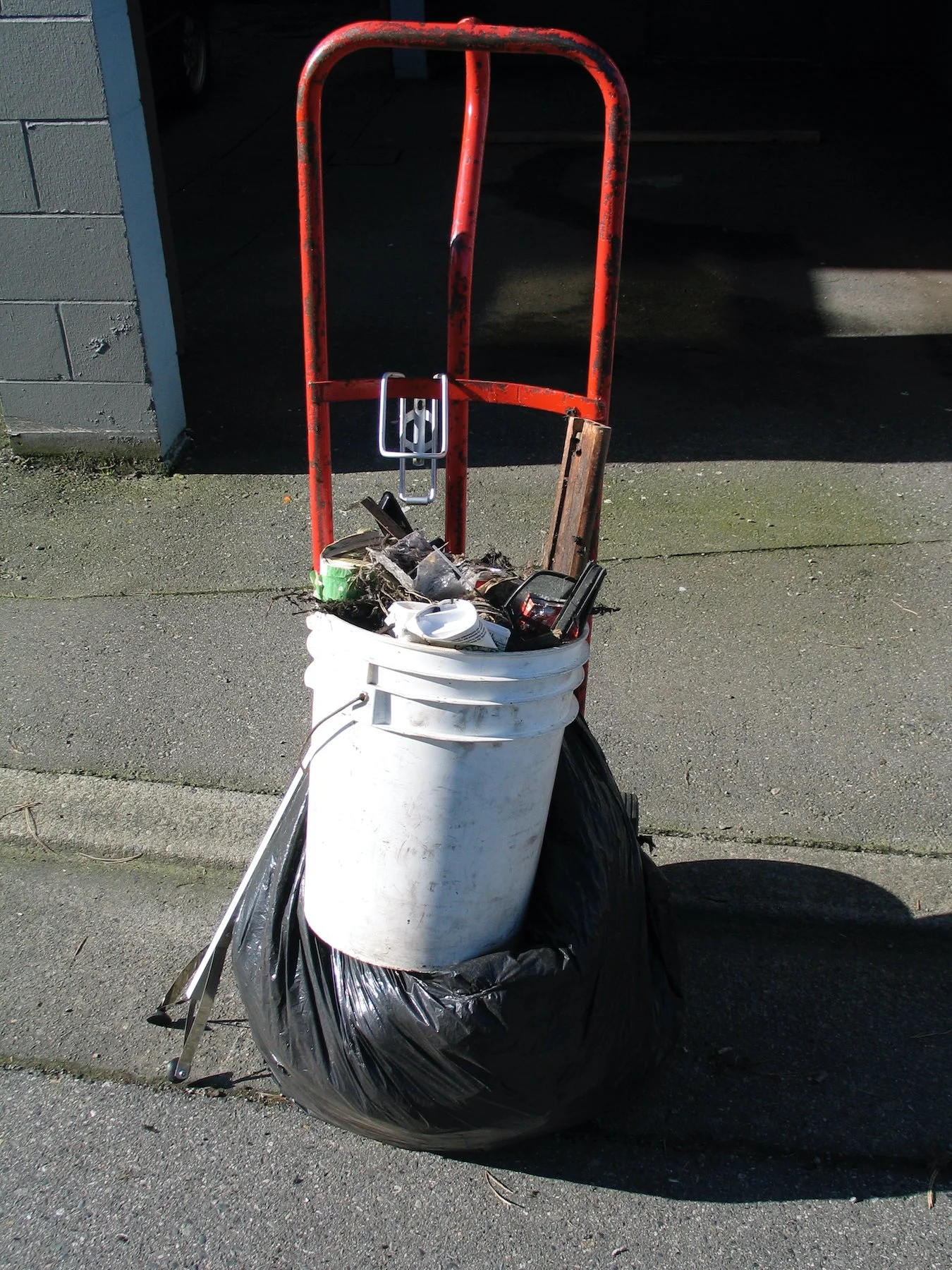
I walked around the corner to the janitorial supply place. I bought a reacher-grabber, the kind that has 2 suction cups at the bottom and a squeeze-grip at the top. You could pick up a dime. I got a 5-gallon pail and I went out into the street. I started by picking up everything I could see from my windows. I kept going, to the end of the block; I came back and did another block. I worked both sides of the streets, and the middle. I got more plastic garbage bags and I filled them up. That first day, cleaning 4 blocks, I picked up 50 pounds of trash. I dragged it across the street to the park and dumped it in the wheelie bin: Park trash only. No domestic garbage. A confusing koan.
The trash collector is invisible. Once I’m out with my bucket and tongs, nobody can see me. People make contorted efforts to pretend I don’t exist; no eye contact, no hello – people pass staring straight ahead, focussed on the podcast in their heads. As castes go, this is as untouchable as it gets. So I make a point of looking at people and saying something, and either they snap me into focus for a second, or walk on in ear-bud deafness. There are some genuine thank-you’s. There are neighbours, there are friends; I’ve learned who they are, what they do – sometimes there are small favours. There are other street cleaners, working for a bed at the shelter, with hi-vis vests, plastic garbage cans bungeed to dollies and a sharps box for the inevitable needles. Or the motley gang sentenced to community service, clustered outside the Community Policing Centre, being handed giant white garbage bags for the few scraps they will collect, with their desultory lack of conviction for the task. Together, on the clock, the whole crew works the block, picking over the picked-over, the laggards with nothing to do dragging their reacher-grabbers behind them. Maybe Honour Students at the high school should be given exclusive trash-cleaning privilege, so that civic improvement achieves meritorious, rather than meretricious, appeal. Then everyone will scrabble over the hi-vis vest and the tongs.
...and the next day it was back. Not as bad, but nearly; I couldn't believe what I was seeing. And then came the second lesson: this will never end. The streets have an addictive habit they cannot break. And so for 10 years I have regularly gone out to do road work. And, gradually, the trashing diminished. I meet people on the street who appreciate my efforts, but at first nobody helped; If I was doing it, they didn't have to. Then one day I saw my neighbor out with a reacher-grabber and a garbage bag...progress! Usually I felt like Sisyphus rolling the Garbage Ball. I realize that like attracts like; trash attracts trash, but my work attracted other collectors. So I kept at my self-appointed rounds, rain or shine. It's a good, healthy out-door work-out, a power-walk around the neighborhood as I pick without breaking stride. Now that the streets are improved, I might only go out every few days.
I consider this decade-long project a work of public art. Street grooming is an aesthetic act, a form of making, not unlike the way an artist works: keep this, get rid of that. Choosing and problem-solving are at the core of any artistic production, and road-work is a remarkable eye-tune: your vision sharpens, your eyes get better. You see things you never noticed before, not just garbage, but the world; you see how the macro and the micro go together. Through repetitive seeing, other things begin to stand out, things that most people have forgotten how to see. You learn a visual connection to an environment in a very intimate way. You take it on; you care how it looks. You learn your place. You see the city.
Social media does the opposite: you are in your screen, you are not in the world. Phatic civility–"good morning, how are you?"–is drained away. Ear buds stopper conversation; no need for human exchange. The noticing diminishes, and the unsightly rises. People no longer pay attention to their surroundings, so they don't see their own garbage. People who see the screen do not necessarily see the world.
I went home, and I looked out the window. There were the same streets, cars, bicycles, people, parks, trees, buildings, cranes, mountains. But the mote had washed from the eye: no trash. A wave of satisfaction sweeps cleanly through; a visual clarity registers. The view now has an immense uninterrupted immediacy; the city can be seen for what it is, such as it is.
The act of grooming a neighborhood is an act of civility. It is also an aesthetic act, like making a work of art. It is the same kind of choosing; as Duchamp said, art is about choice.
In the 26 years I’ve been doing this, I’ve learned that there are limits to what I’m prepared to do. I don’t do leaves, flowers, feathers, dog poop. If something seems valuable, I put it on the Lost and Found. If it's not claimed, I sell it on Craigslist. If it’s a major laneway truck-emptying trash dump, I take a picture and send it to the city. They have an app for that. I do my own recycling, but I'm not going to do everyone else's. What goes in the garbage goes in the landfill...and don’t get me started on the landfill problem.
Oh, and cigarette butts...I don't do cigarette butts. Sorry.