A Speculation on the St. Francis Altar
An investigation into possible lighting effects by Bernini,
supported by an SFU President's Research Grant, 1988
Gianlorenzo Bernini (1598-1680) is commonly regarded as the greatest sculptor and architect of the Roman Baroque. His work has attracted an enormous body of near-exhaustive commentary on all aspects of its production. His development of an integrated relationship between architectural space and theatric illusion has ben an area of particular interest to artists and scholars.
The proposed investigation has to do with an aspect of Bernini's work not referred to in the literature (Lavin, Hubbard, Portoghese, Wittkower), and which may shed light on the relationship between Bernini's considerable theatrical work and his architectural constructions produced for religious effect. It may show this relationship to be more subtle, sophisticated and complex than previously thought.
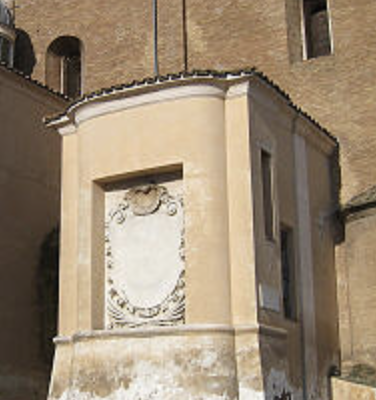
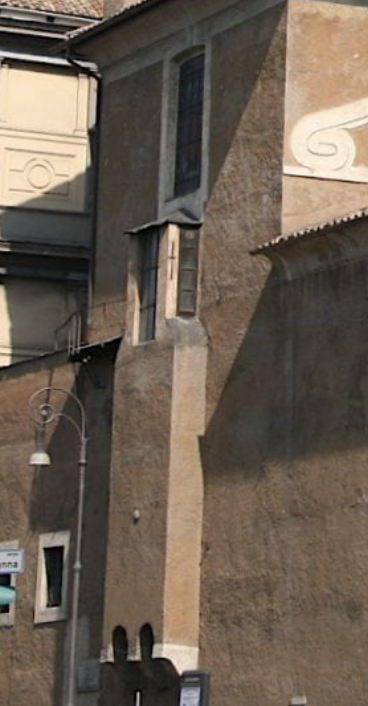
Bernini's Raimondi Chapel, in San Pietro in Montorio in Rome, constructed between 1638 and 1648, is the artist's first use of a concealed light source for dramatic effect. (In the exterior picture below, the narrow vertical side-light window can be seen on the right side of the chapel.)
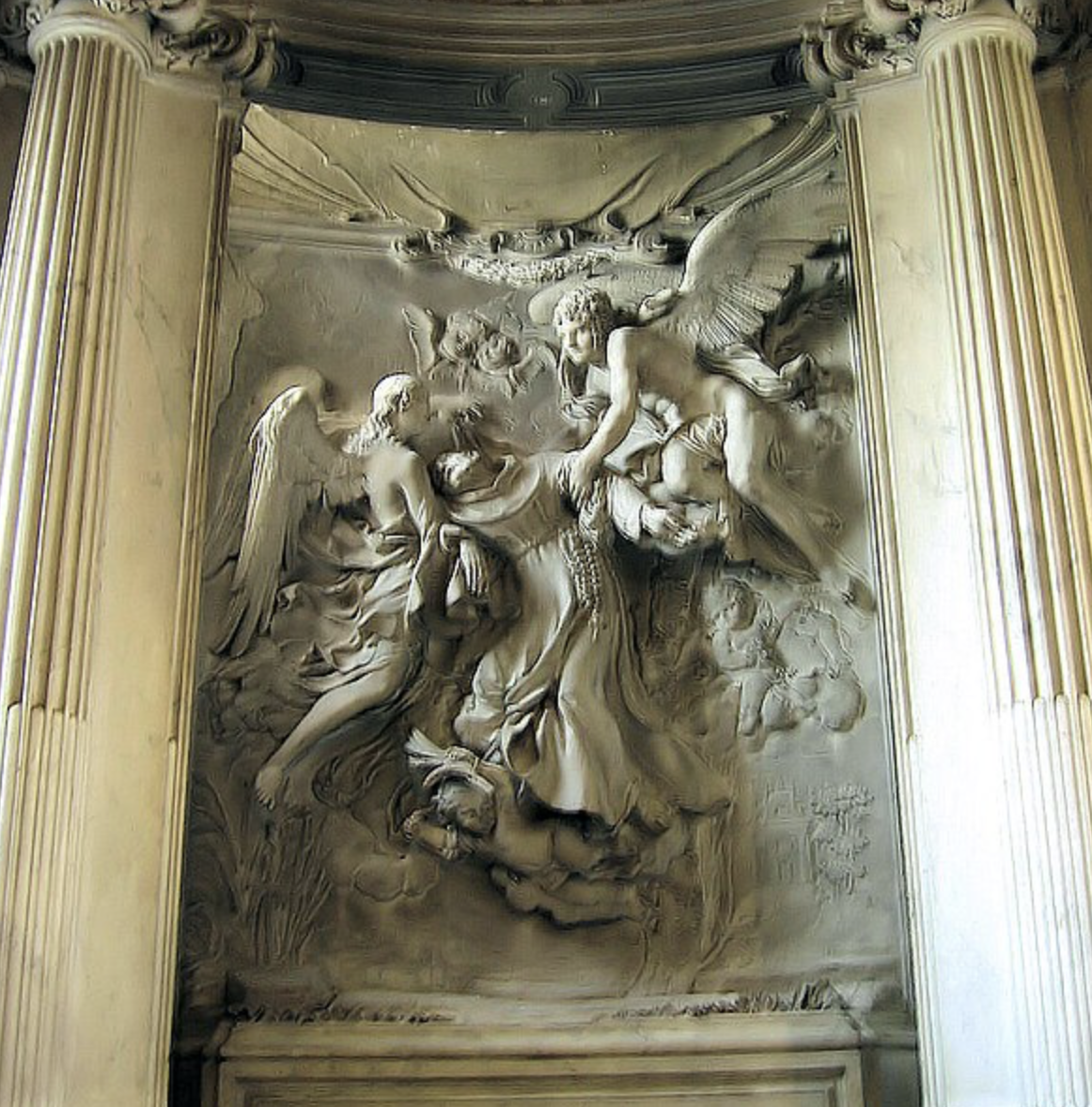
The raking sidelight highlights a carved white marble altar relief (one of the first examples of this form) of the Glorification of St. Francis, produced to Bernini's design by Francesco Baratta. There is a characteristic of this carved relief which seems intriguing and worth pursuing: is it possibly a translucent panel?
The panel of the relief is concave inside the chapel, while its back appears flat. This concavity, undercut around the central figure of St. Francis, renders the marble thinnest along this contour.
It is my hypothesis that since the back of the slab appears exposed on the outside of the chapel, and given the translucence of white statuary marble it might be assumed that under proper external lighting conditions, this would cause the figure of St. Francis to appear haloed with an aura of suffused light as it passed through the marble.
The technique of using thin marble or alabaster slabs as windows to diffuse coloured light into an interior is not uncommon in Italian architecture, and Bernini's technical knowledge of the characteristics of marble, combined with his sense of theatric lighting effects, could possibly have been brought together in a profoundly literal depiction of St. Bonaventure's description of St. Francis' Apotheosis, as described in his Life of St. Francis:
"There he was beheld praying at night, his hands stretched out after the manner of a Cross, his whole body uplifted from the earth, and wrapped in a shining cloud, as though the wondrous illumination of the body were a witness unto the wondrous enlightenment of his mind."
This seems to me exactly the kind of direct representation Bernini continuously strove for and which would be compatible with his employment of St. Ignatius Loyola's Spiritual Exercises, which guided Bernini in his development of realistic effects. That this device has passed unnoticed by generations of Bernini Scholars I would attribute to physical changes on the external surface of the marble. Overpainting with whitewash or resurfacing with stucco would render any translucent effect opaque. This can only be discovered through direct examination and measurement of the existing chapel, and the observation of any changing light effects.
Summary of Investigation
In February of 1988 I travelled to Rome, under an SFU President's Research Grant to pursue an idea I had about the appearance of the St. Francis Altar, completed under Bernini's direction, in the Raimondi Chapel of the church of San Pietro in Montorio.
Through Gilbert Reid of the Canadian Cultural Centre in Rome, I was able to make an appointment with the Padre Superior, Padre Paulo, to visit the chapel which was closed for renovation. The chapel was filled with scaffolding and access to the altar was difficult and dark, but in the course of several visits I assembled a series of photographs and measurements of the altar from the inside and outside (on a small ledge 5 meters off the ground reached by ladder.) The basic problem was to discover how thick the marble of the altar was, and whether or not it was a monolithic slab or a later laminate. If the latter, then any possible original translucent effect would have been rendered ineffective.
In the course of my close examination, I discovered a crack in the slab on the upper left corner, about a meter long, running parallel to the left side. This crack is clearly visible on the outside in the upper right corner, which confirmed that the altar is a monolithic marble slab.
My estimation of the thickness of the outer walls of the chapel were approximate, derived from the small window to the left of the altar entering at an angle through the masonry, and which is obscure by grime, wire screening and iron bars. Calculating the difference between the depth of the carving on the concave face of the altar (about 50 cm.) it appears that the slab at its thinnest point is between 18 and 30 cm. thick, which would definitely preclude the passage of light.
Consequently it became evident that the altar was never intended to do what I thought it might; that is, act as a transmitter of light to produce an auratic effect around the central figure of St. Francis. This was reinforced by a close look at the carving of the figure itself, where no systematic attempt was made to reduce the contour of the figure to a consistent depth. As well, a heavily weathered boss in the form of a shield on the outside adds several centimeters to the overall thickness directly behind the figure.
Appendix: The Cornaro Chapel
Despite the disappointing conclusion of this project, I did have the opportunity to notice the intentional use of reflected light by Bernini in the church of San Andrea al Quirinale, where the sloping elliptical roof above the side chapels, below the ring of the dome, acts to bounce light through a series of upper windows onto the domed vault above.
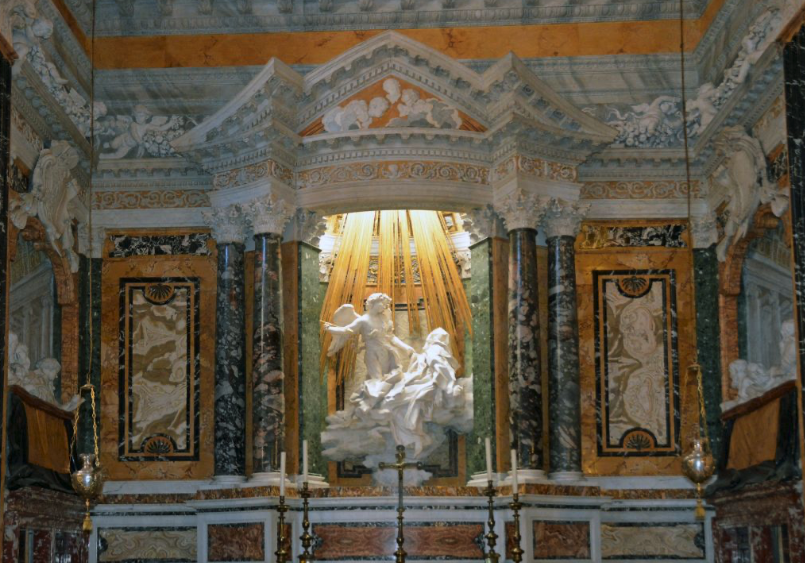
Another better-known example of Bernini's constructed use of reflected light is in the Church of Santa Maria della Vittorio, which houses the Cornaro Chapel and the celebrated St. Teresa in Ecstasy.
A very theatrical production, the chapel includes viewer's boxes on either side, containing carved figures of the Cornaro family, witnesses to the miraculous event. It has long been known that the figure of St. Theresa is lit by daylight from above by a hidden window through the exterior wall.
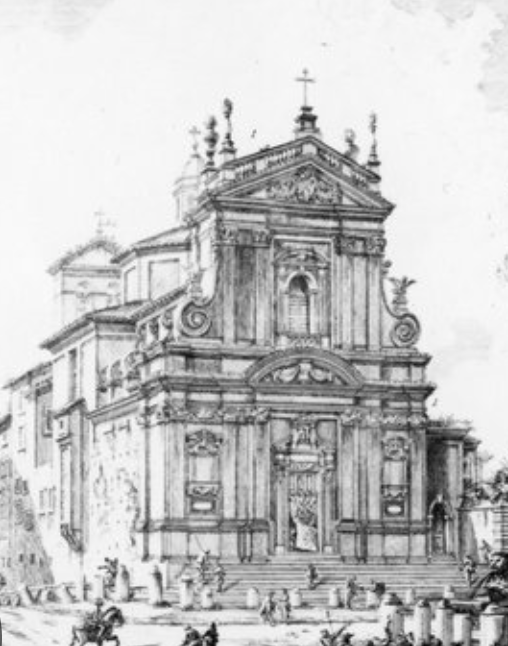
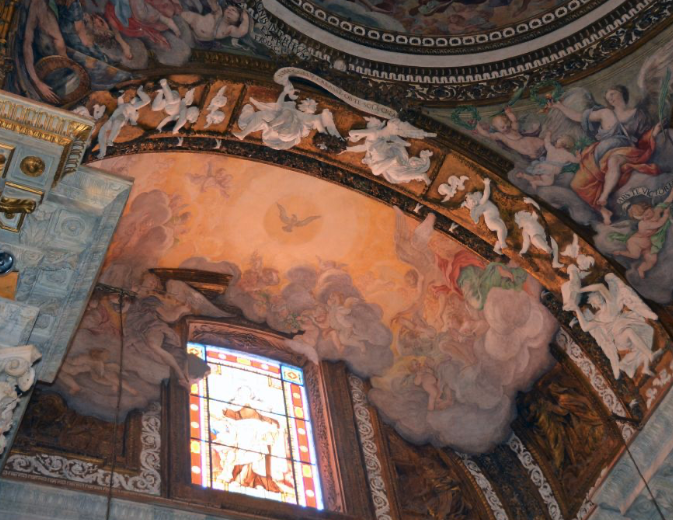
Piranesi's etching from a hundred years later (1760) clearly shows an attached structure with a sloping roof on the exterior of the chapel, with a square window just below the roof. It is this window that originally allowed light to illuminate the St. Theresa. Another larger window, above the sloping roof, provides lights to the top of the chapel vault, where a fresco by Abbatini represents the Holy Spirit in the form of a dove (below).
But a second feature of this structure is less remarked upon. It is worth noting that this sloping roof could potentially bounce light through the window, upward onto the ceiling of the interior vault, especially if the roof had been whitewashed for better reflection. But this original construction, shown in Piranesi's etching, has since been completely changed.
Here is the exterior structure as it appears today. Note that the small square window is gone, and three tall vertical windows now provide light for the St. Theresa. (No doubt tit was found that the original window provided insufficient daylight for the sculpture.)
Another change is that the shed roof is gone, replaced with a smaller three-sided roof, that probably could not cast much light through the window above.
It is my supposition that Bernini intended the original sloping roof to provide strong reflected light to the interior vault above, and subsequent changes to the exterior structure have made this no longer possible.