
The Crab
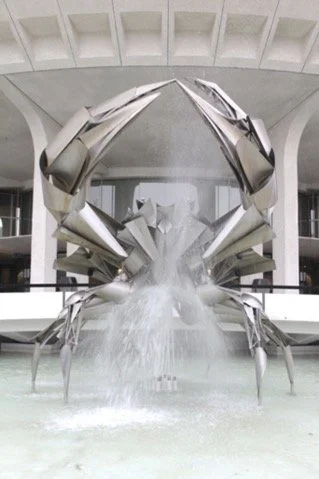
Photo: Maxime Cyr-Morton
THIS FOUNTAIN MADE BY GEORGE NORRIS
WAS COMMISSIONED BY THE WOMEN’S ACTIVITY GROUP
OF THE CENTENNIAL COMMITTEE OF VANCOUVER AS A
GIFT TO THE CITIZENS OF VANCOUVER
BENEATH THIS PLAQUE IS A TIME CAPSULE TO BE OPENED
ON CANADA’S BICENTENNIAL, JULY 1, 2067
THE CRAB WAS LOOKED ON BY THE INDIANS AS THE
GUARDIAN OF THE HARBOUR AND IS ALSO THE SIGN OF
THE ZODIAC FOR THE PERIOD BEGINNING JULY FIRST
CANADA’S BIRTHDAY
Bronze plaque in front of the Vancouver Centennial Museum, Vanier Park, Kitsilano
On Monday, May 15, 1967, at Hycroft House, home of the University Women’s Club in old Shaughnessy, Mrs. Wallace (Marion) Coburn, co-chair of the Women’s Activity Group of the Centennial Committee of Vancouver, unveiled the winner of a competition for a fountain-sculpture for the new Vancouver Centennial Museum. The successful entrant was 39-year old George Norris, a Vancouver artist who proposed The Crab for the $50,000 commission (about $500,000 today.) That October, Mrs. William Lane (Betsy to her friends) sent a fund-raising letter to Stuart Keate, the publisher of the Vancouver Sun, praising the “unique and very beautiful crab concept” which would become “the finest permanent memorial” to the city and its citizens, a gift from the women of Vancouver.
In terms of public art and participation, several remarkable things about the accomplishment of the Women’s Activity Group remain relevant and are in contrast to current public art processes. Their strong proto-feminist sensibilities surfaced at a moment of international advocacy for improved women’s rights, a fact woven into their determination. The social, collective, charitable and voluntarist impulses behind their work can still be regarded as models for successful community engagement. Today, the increasing privatization and internationalization of ‘public’ art makes reflection on their accomplishment even more impressive, and may serve as a useful example. Currently in Vancouver as elsewhere, public art often occurs under arrangements that are not particularly public, reflecting larger impacts of privatization and exclusivity within the public sphere. To an unfortunate degree, this undermines the concept of ‘public’ itself. It does mean, however, that a city gets lots of public art of a sort, but on terms quite different from that of The Crab.
Leading up to Canada’s Centennial Year in Vancouver, the Women’s Activity Group sponsored the competition for the sculpture and raised money for its creation. This unusually committed and dedicated volunteer group of women conceived a project they could organize, manage and fund-raise for. The “jewel in the crown”–as the museum’s project architect, Gerard Hamilton, envisioned it–would be an outstanding aesthetic feature in front of the new building, complementing its dramatic modernist architecture.
The three principle fund-raisers were the co-chairs of the Women’s Activity Group, Winnifred-Mather Hillman and Marion Coburn, along with Betsy Lane, a Director of the Centennial Committee. Remarkably, these very social women were connected to over 150 women’s organizations in the city to whom they appealed for funds and support. In addition they conducted a direct-mail campaign to over 800 women’s groups, companies and individuals across the country and internationally. Their ambitious and risky goal was to raise $50,000 to pay for the artwork and the fountain installation. In their solicitation letter they were adamant that these efforts were “for Vancouver’s women, by Vancouver’s women”.
The fund-raising resourcefulness of the Group was impressive. In October 1967 Hillman, who had been a Powers model in New York and a fashion writer for McCall’s magazine, organized fashion shows on board the Alaska Cruise Liner Polar Star, then berthed in Vancouver, with lunches, dinners and cocktails. That same month, an event at the Vancouver Playhouse featured a documentary film called The Lace Trimmed Iron Curtain; intermission included a show of evening gowns and luxury furs; desert was provided by the Bon Ton Bakery. “Donational Teas” were organized by a number of local women’s groups. In the end, they directly raised close to $7000, and successfully arranged a $20,000 contribution from the Centennial Committee itself. The City of Vancouver committed another $24,000 toward the fountain infrastructure.
Of the hundreds of public sculptures in Vancouver–some costing thirty times more than The Crab–few are as popular or durable in the common imagination as this one. Norris imagined the work as a layered metaphor, linking the project and the place with its object. His prospectus for the work outlined three features: in Haida mythology, Crab is the guardian of the harbour; in astronomy, Crab is the largest northern constellation; and in astrology, it represents Cancer, one of the twelve signs of the Zodiac, and Canada’s sign on its centennial, the first of July, 1967. But what makes the work continuously engaging for its audience is its immediate and palpable material impact: light and air mix with steel and water mix with sea and sky mix with crashing sound–the amalgam of nature and culture renews its visual contract with the viewer on every encounter, as the fountain’s rising shock of water hits and blows it alive.
Over the past half century, ‘world class’ cities have mounted increasingly rich commissions, particularly around moments of international spectacle such as Expo 86 or Winter Olympics 2010, when cash flows fast and loose. Substantial works of art by internationally-recognized artists make a city a cultural destination, drawing thousands of tourists and millions in revenue. A personal landmark by a known artist reflects a city’s cultural bona fides. This is normative, and troubling. It reinforces claims to private individual expression at the expense of more compelling social reflection, drawing resources from more urgently-needed critical public art. The singular work by the singular artist is only one possible model for work in the public sphere, and in many ways it is the least useful. While it allows a city, or a developer, to truthfully say “Look, we have work by...” But over-attention to the personality of the artist can obscure the actual work itself; ideas contained in the work, or how the work functions contextually, or what the work refers to other than itself, or even whether the work fits the guidelines of the competition can be overshadowed by the brand name of the artist. Privileging art by certain artists at the expense of their critical reception reveals a conservative motivation, to give us forms we’re familiar with, and histories we know. It contributes to the universal distraction necessary to maintain an inability to see our way out of current social, political and ecological dilemmas. The risks taken by property developers (the major beneficiaries of public art) are so carefully managed in advance as to be hardly risks at all. Possibilities for funding experimental, radical, critical or innovative work are low, under current policy, and as a result the majority of works produced through this process are relegated to amenity–something with the potential to add perceived value to a development project, and status to a community. In addition, being on private property, they can be pulled at any time–there is no commitment to them other than their attachment to a building. Although commonly regarded as a public process, the current procedures of public art selection and disposition give undue weight to interests of property owners and developers, who are free to choose works for their ability to add sales value and cachet to marketing developments and private property.
Standing 18 feet tall, with upraised claws, blasted by roaring water from the fountain below, the dynamic image of The Crab is perhaps the best-known and most-photographed work of public art in Vancouver. It is the largest free-standing animal sculpture in the city, over seventy times life-size. Made of rolled, spun and shaped plates of polished stainless steel welded to an armature of stainless rods and tubes, the work is a semi-abstract representation made up of a complex space-frame of lines and planes. The openwork baffles of its configuration deflect the powerful hydraulic jets blasting up underneath, covering the work in spray and misting it over with a rainbow sheen. The new sculpture was locally built by regional craftsmen like Gus Lidberg, who spent three months welded it together at the Ellett Copper and Brass Company at 92 West 2nd Avenue, specialists in stainless steel equipment for the pulp and paper industry. It was then barged a mile and a half down False Creek to its present location, where it was installed in October of 1968. George Rammell, a Vancouver sculptor who watched its arrival, recalls seeing a huge spectre emerging out of a dense fog; an unreal moment as The Crab came to land. Today, it would more likely have been built in another city or country, in a factory specializing in international public art, and shipped at great hydrocarbon expense to Vancouver, like many contemporary public artworks in Vancouver.
It is instructive in this context to consider one particular example: the peregrinations of Myfanwy MacLeod’s Birds, at Olympic Village. The Birds were one of four major commissions awarded before the 2010 Olympics, each in the $700,000 range. First manufactured in Calgary by Heavy Industries, out of hard-shell plastic and dense-foam filling, the birds were trucked to Vancouver and installed. Within a few years, the plastic shells had been crushed through by aggressive skateboarders. The Birds were deinstalled and shipped back to Calgary, stripped, repaired and new molds made of each. These travelled to China, where aluminum casts were poured; the pair then made their way back to Calgary for finishing and painting. Finally the birds flew back to Olympic Village and alighted. The second birds cost around $1.5 million.
It remains instructive to consider the context in which the work of the Women’s Activity Group appeared and what has happened since. When The Crab was produced, there was little public art in the city; no formal mechanism for the development or placement of such work existed, and no financial system of grants or awards or development money to support civic projects was in place. Over the past 45 years, as public and private funds have become available for a range of public artworks, policies and procedures have been established by the City to manage its selection and production, no doubt encouraged by questions raised regarding the city’s involvement with The Crab. But it was not until 1990 that the City finally approved a Public Art Program that had been in the works since Expo 86. Previously, artworks either gifted or proposed to the City were managed on an ad-hoc and case-by-case basis, a serendipitous and confusing approach that resulted in a variety of works sponsored by various City departments, from the the Parks Board and City Engineering to Social Planning. (The gift from Seward Johnson of Photo Session (1984) to the City of Vancouver, was managed by the Parks Board and installed in Queen Elizabeth Park.) The Public Art Program was intended to bring some order and consistency to the city’s relationship to public art, through management of selection processes, juries and project opportunities, but there was still the vexing problem of how to pay for it all.
Vancouver, like other cities, has adopted a strategy for funding public art popularly known as the “1%” model. An amount equivalent to one percent of the total capital cost of a development is set aside for artworks, either major commissions or portable works. (There are a few variations on this theme; in practice it may be tied to rezoning and square footages–Vancouver’s policy stipulates $10.23 m², and kicks in when projects exceed 15,000 m²). In fact, in a remarkably candid admission, the Public Art Guidelines for Private Development state clearly that they “ are intended to minimize civic involvement in the public art process.” Along with the art, the developer is expected to pay for all costs of the art selection process. Needless to say, not all developers are happy with this arrangement, but there is an escape clause: if developers don’t like the results of the process and the art being proposed, they don’t have to accept it. They can chose their own art and artists, as long as they spend the money. Or they can give the money to the city, which goes into a Public Art Reserve to be used for public art. Works are solicited and adjudicated by the Public Art Committee. (As an example, Ken Lum’s very popular East Van sign at Clark Drive and Great Northern Way was built through this program.)
The Women’s Activity Group was able to get The Crab paid for, built and installed. Through their perseverance, women who understood the potential of networking connections and individual contributions to a shared purpose accomplished something of significance. Setting an example for communal civic engagement still relevant today, they committed to a broad social base and a belief in community action. It is notable that Betsy Lane was at that time also President of the Vancouver chapter of the Junior League, an international women’s organization founded in New York early in the 20th century on principles of social reform. With an educational and charitable mandate dedicated to promoting community improvement and encouraging voluntarism, the Junior League offered training in civic leadership to women under 40. The Vancouver chapter had initiated a survey of the arts in Vancouver shortly after WWII, which led to the development of the Community Arts Council, an important advocacy group active in the development of the Vancouver Playhouse and the Queen Elizabeth Theatre.
The competition terms prepared by the women state that the winning entry should “reflect our past, mirror our present and give a hint of our future.” An all-male “Group of Assessors” was chosen, consisting of the Director of the UBC School of Architecture, Henry Elder; Warnett Kennedy, Director of the Architectural Institute of Vancouver; Gerard Hamilton, project architect; Philip Tattersfield, project landscape architect; Deputy City Planner Harry Pickstone; and engineer D.W.Thompson. Eighteen artists responded to the open call. A short list of four was chosen–Gerhard Class, Jack Harman, Elza Mayhew and George Norris. Mayhew, the only woman, dropped out to work on another commission. Final adjudication took place in the basement of the old Vancouver Art Gallery, on Monday, April 10, 1967, and George Norris’ proposal for The Crab was selected.
The crab moves sideways. The Women’s Activity Group appealed to people who gave their time and money to the realization of a substantial public project; many were of modest middle-class backgrounds who understood what it meant to make a contribution, and wanted to be part of that. Long before the wild disparities of wealth and privilege became distorting norms in modern life, these people demonstrated a fundamentally populist idea; they wanted to give back to their city something broadly shared within the community. It was not a question of personal or financial aggrandizement; it was a collective impulse, dedicated to what could be done for a city by its citizens, without superimposing a private vision on an indifferent population.
At this moment in our historical development, the real problems of environmental and social degradation have become staggering, and ever-increasingly urgent; water, air and earth are now questions rather than answers. Beyond what the women imagined or current processes provide, a new approach to public art is called for, one which will bring to our reflective attention what we are actually up against, showing us the things we need to pay attention to. Like The Crab, they will come out of a process of social interaction and shared concern, and not out of an exclusive process of separation and disenfranchisement. By offering us works that engage us physically and mentally, we may come to our own conclusions about what is to be done in the tasks of restitution before us. These will not be didactic or tendentious works, formed out of late modernism's unrelenting desire for abstract and formalist self-referentiality, but will establish conditions to allow considered thought of a cogent percipient to bear on what is actually critical and urgent in contemporary experience. They will be constant mnemonics, reminders that will not let us forget. We do not know where they will show up or when. We do not know how long they will be around. They will be constantly replaced with something else. What these works will look like we don’t know, because they have not so far made their appearance. They will not be trivial. They will be sober and serious. They will make us change our minds.